Category Archives: Uncategorized
BOYS need BINS


We are currently working closely with a number of organisations on developing a campaign to encourage government to devise a legal requirement for the inclusion of sanitary bins in Mens Toilets.
Over 2 Million men across the UK may have an urgent need to visit the toilet to remove or replace a stoma or incontinence product. Until now the soiled unit would have been disposed of in a Litter bin (if provided) or they may be forced to carry the used item away from the toilet perhaps to home.
Female toilets have always been well provisioned with sanitary bins in nearly every cubicle to cater for the disposal of towels & pads.

In recent months we have joined forces with Prostate Cancer UK and together we are gathering research and evidence to support our lobbying of national government to make a change in the current legislation to make it compulsory for providers to address the needs of all males who suffer with the problems of proper disposal.
A nationwide email survey has been distributed by supporting organisations to all their members and major organisations providing public toilets. These results will help us to try and understand the extent of the problems being faced by both the users and the providers.
WE NEED YOUR HELP !
The BTA are supporting the All Party Parliamentary Group for Bladder
and Bowel Continence Care’s campaign called Boys need Bins. The campaign aims to raise awareness of male incontinence and examine what facilities currently exist for incontinent men. We’ve partnered with
other national charities/associations to help achieve this:
- British Toilet Association
- Bladder Health UK
- International Longevity Centre (ILC)
- Men’s Health Forum
- Prostate Cancer UK
- Tackle Prostate Cancer
- Truckers Toilet UK
How you can help
We’d like to hear from those responsible for the hygiene provisions in your toilet facilities, to get an
understanding of the current need for male hygiene bins. If this isn’t you, please forward this email on to
the most relevant person in your organisation.
Our 5-minute survey is completely anonymous and asks for no personal details, so please share as much
detail as you want. There are no right or wrong answers.
https://project.tolunastart.com/tqsruntime/main?surveyData=ewqEMryCmi3LgTze45dHLMZCvYremf0kCcxST2LGWp2oe+/cAaUPfZeF1+qBMT9s
Your feedback will help us start conversations with the Government and key decision makers who can
create a positive change for men affected by incontinence.
The deadline for submission is Friday 26 May 2023.
If you have any questions about the survey, need support with completing it, or want more information on
this topic more generally, please contact campaigns@prostatecanceruk.org
With our thanks and best wishes,
Raymond
New Bill for Public Toilets moves to the Lords
In October of 2022 a “Levelling Up and Regeneration” Bill was introduced into Parliament by Ministers that will address a number of issues that the country facres ciming out of Covid and redressing the decline in local services and planning. The Bill has passed through the Commons and is now being read and debated in the House of Lords. It is hoped that the Bill could become an ACT of Parliament before Easter 2023.
It is with great delight that The BTA can report to all our Members Colleagues and Friends that within this Bill is a section specifically relating to much of our unrelenting work and ethos over the last twenty years.
Clauses 57, 58 and 59 refer directly to the appointment of a Toilet Commissioner whose priority will be to access the provision and need for public toilets throughout England and put in place a National Strategy for Local Authorities to follow – to devisie a Toilet Plan for each council area.
Working with an Independant Panel of advisors the commissioner will have to report to the Secretary of State for the Dept of Levelling Up and funding should become available for LA’s to enact some new developments.
The BTA will, of course, be offering oits full support to the Commissioner ,the government and Local Authorities in assembling and completing these tasks within the given timeframe. However, it is hoped that this is an exciting begining of a more sustained stategy for the future toilet provision across all the nations.
The following is an extract from the Hansard Report
New Clause 57
Review of England’s public conveniences
“(1) The Secretary of State must, within 6 months of the day on which this Act is passed, appoint commissioners to consider the level of need for public conveniences in England and the extent to which current provision matches that need.
(2) The Secretary of State must publish the report of the Commissioners before the end of the period of 12 months beginning with the day of their appointment.”
New clause 58—Public convenience plans—
“(1) Each tier 2 local authority in England must produce a Public Convenience Plan for their authority.
(2) A plan under this section must be formulated in consultation with local partners and the public.
(3) Such a plan much consider—
(a) the current level of public convenience provision,
(b) the current level of demand for such conveniences,
(c) what gaps there are in provision, and
(d) the needs of communities with protected characteristics under the Equality Act 2010.
(4) Central government must provide funding to local authorities to cover the costs of this new responsibility.”
New clause 59
Business rate relief scheme for business making toilets publicly available—
“The Secretary of State must by regulations make provision for a scheme under which if a business liable to business rates permits non-customers to use their toilets as a public convenience, the area of the premises containing the toilets is discounted from the calculation of the premises’ overall rateable value.”
In 2016 a BBC report highlighted that local authorities had closed one in seven public toilets between 2010 and 2013. The report identified 10 areas in England and Wales with no council-run toilets at all.
By 2018, the follow-up report found that the number of areas without any public conveniences had increased to 37. That is a trend likely to accelerate with the pressures on local authorities.
It has led to closures or transfers to perhaps voluntary groups or charities. The good will engendered in that is a welcome thing, but it means that accountability for that essential social infrastructure has been lost. We have to be clear about this. I do not think public toilets are a “nice to have”.
Lack of adequate facilities disproportionately affects all sorts of groups, including people who work outdoors, people with ill health or disability, the elderly and the homeless. Such essential facilities can make the difference between being able to confidently leave the house or not.
Improved Legislation and more funding needed
8th June 2026
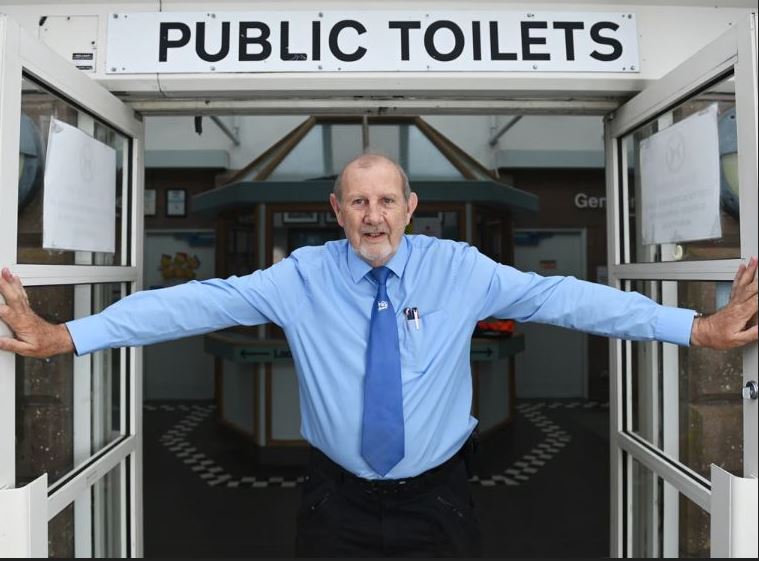
The British Toilet Association has called for improved legislation and more government funding to address the current “appalling” lack of public toilet provision.
Public toilets are in “crisis” and rapidly vanishing, the body said, with many of those that remain displaying totally unacceptable levels of cleanliness and hygiene and our state panic and withdrawl during the previous pandemic has only made the situation worse.
Many public toilets have been locked down since the end of the pandemic due to a lack of funding, proper management, cleaning or any government guidance on how to get them hygienically fit for purpose.
The public was being forced to go to the toilet in streets, beaches, open spaces and beauty spots, causing street fouling figures to escalate, aggravating the risk of transmission and leaving the local authorities to foot considerable clean-up costs, it added.
The effects of the LOO LEASH
“Anyone suffering with an accessibility issue or those caring for someone who has limited mobility or a medical condition is socially excluded and potentially deemed prisoners in their own homes.”
–Raymond Martin
Managing Director, BTA
No Legal Requirement for Local Authorities to Provide Public Toilets
With no legal requirement in place to support or even force local authorities to provide publicly accessible toilets then, the BTA firmly believes that the majority of councils across the UK can not allocate sufficient resources or funds to the provision of public toilets.
It is calling for the government to make sanitation and hygiene a major priority and support local authorities to stop the closures, open new facilities and establish a new set of standards of hygiene and cleanliness.
The BTA has been lobbying for action since the pandemic began, asking questions of Ministers and the PM and attending meetings with the Ministry of Housing, Communities and Local Government. We have spoken directly to the previous Secretary of State for MHCLG Alex Norris MP and has taken part in a series of Zoom meeting with other Members of the House of Commons and the Lords and has been encouraged to find a willing audience who understand the problems and priorities and are currently raising the questions in Parliament and at council levels.
We are in the process of writing again to the Rt Hon. Steve Reed to ask him to meet with the BTA to progress the previous proposals and discussions.
The BTA is a not-for-profit organisation that campaigns for the highest possible standards of hygiene and provision in all “away from home” toilet facilities across the UK. It understands that over a third of the population need to visit a toilet on an urgent basis, often at very short notice.
BTA Managing Director Raymond Martin said: “We are appalled at the total lack of funding over many years and extremely concerned at the closures and unprecedented low levels of public toilet facilities before, during and going into the future. This is now a crisis.
“Across our beautiful country, that was once the envy of the world because of its sanitation systems and hygiene controls, those responsible have allowed us to fall so far from the standards our forefathers achieved.
“Then along comes one of the deadliest pathogens for many generations and unbelievably our ministers and their government colleagues cannot see the need or make available any primary funding to make sure that our public toilet providers and cleaning operatives are ready, skilled and prepared to tackle and fight any threat to our nation’s daily existence.
“Hand washing materials cost money, hot water costs money, cleaning materials and staff cost have to be factored in, as well as the return to an acceptable level of provision.
“The lack of public toilet provision leaves families with young children, business travellers, drivers delivering our daily essentials across the country, staycationers, day-trippers those on longer holiday breaks, older persons wanting to visit family and many more people wondering when they might find comfort, convenience and relief.
Accessibility Issues
“Anyone suffering with an accessibility issue or those caring for someone who has limited mobility or a medical condition is socially excluded and potentially deemed prisoners in their own homes.
“Footfall in shops and many high streets continues to remain low as the lack of decent toilet facilities is driving shoppers away to out of town superstores, leaving the villages and town shops with diminishing revenues and the constant threat of closure.
“The BTA has spent many years primarily firefighting the lack of publicly accessible toilets across the UK but with very limited success without the support of this government.
“It’s time that this government made sanitation and hygiene a major priority and supported the local authorities to stop the closures of public toilets, restore standards and tackle this pandemic in our public buildings and spaces.”
2025 The Dawn of a New Era
To All our Members, Partners, Friends and Colleagues we send you our Warmest Wishes for a vibrant and successful year ahead.
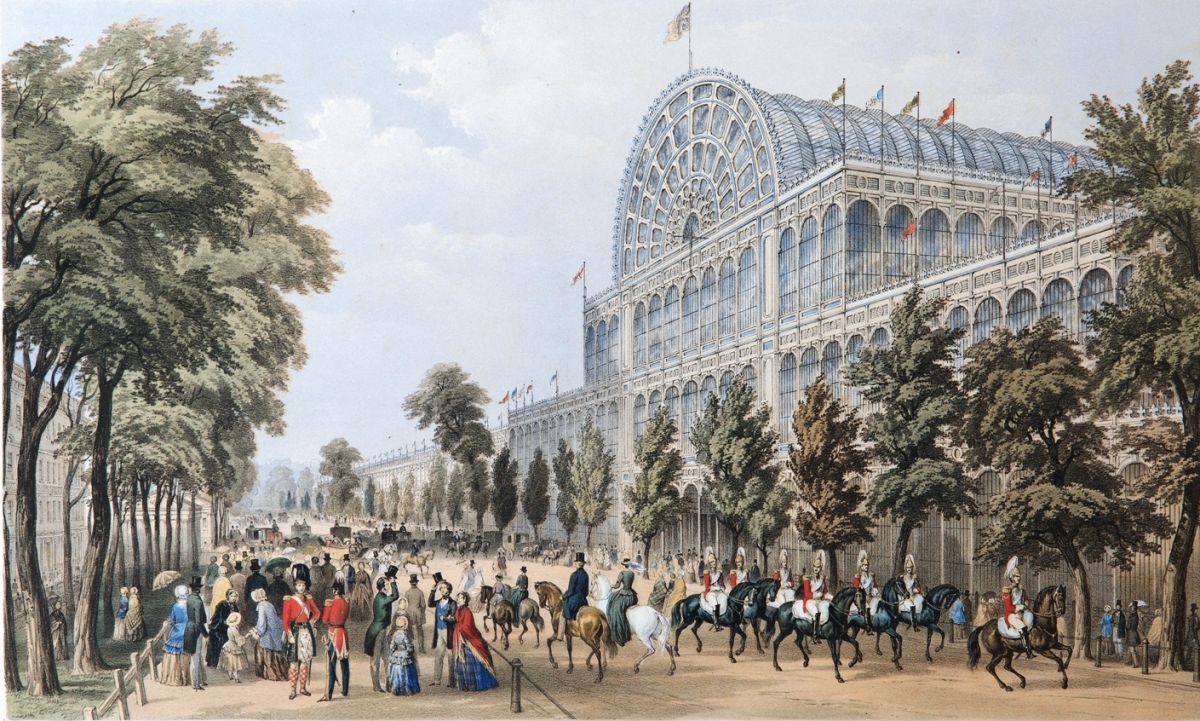
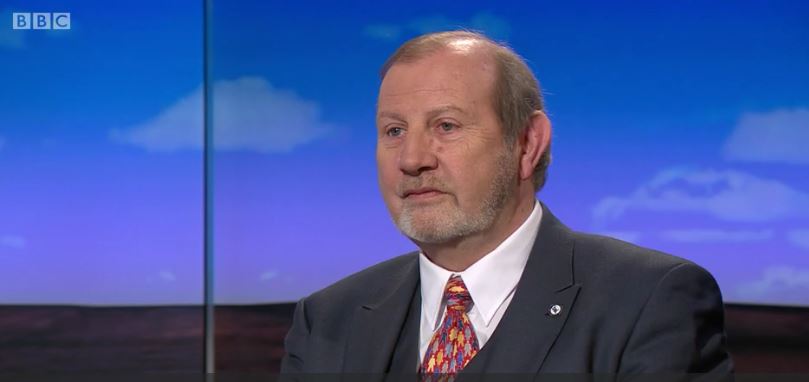
“I truely believe our new political campaign is gaining great traction and if we all work together we can make 2025 a year of renewed hope. Since its inception in 1851 the public toilet has risen and fallen in public conciousness many times. We once were the envy of all nations and our hygiene standards were exemplorary. But how they have diminished in the last 20 years – to the point of this country closing over 60% of its publicly accessible toilets and allowing the remaining units to fall into such dire repair and poor levels of cleanliness and hygiene. If Covid taught us anything it should have been to raise aour standards of cleanliness, hygiene and provision to combat the increasig threat of disease and transmission of germs. We need to renew our ight to decent clean sanitation and hygiene in readiness for the next pandemic.
The New Labour government is currently extremely interested in engaging with the BTA and hopes are high for a future public toilet strategy and a close working agreement. Also we look forward to working closely with many charities, organisations and individuals to help raise the standards of all “away from home” toilets, washrooms and bathroomSince the launch in 1851 s across the UK & Ireland”
Raymond Boyd Martin
Managing Director
FELLOW of the Royal Society for Public Health
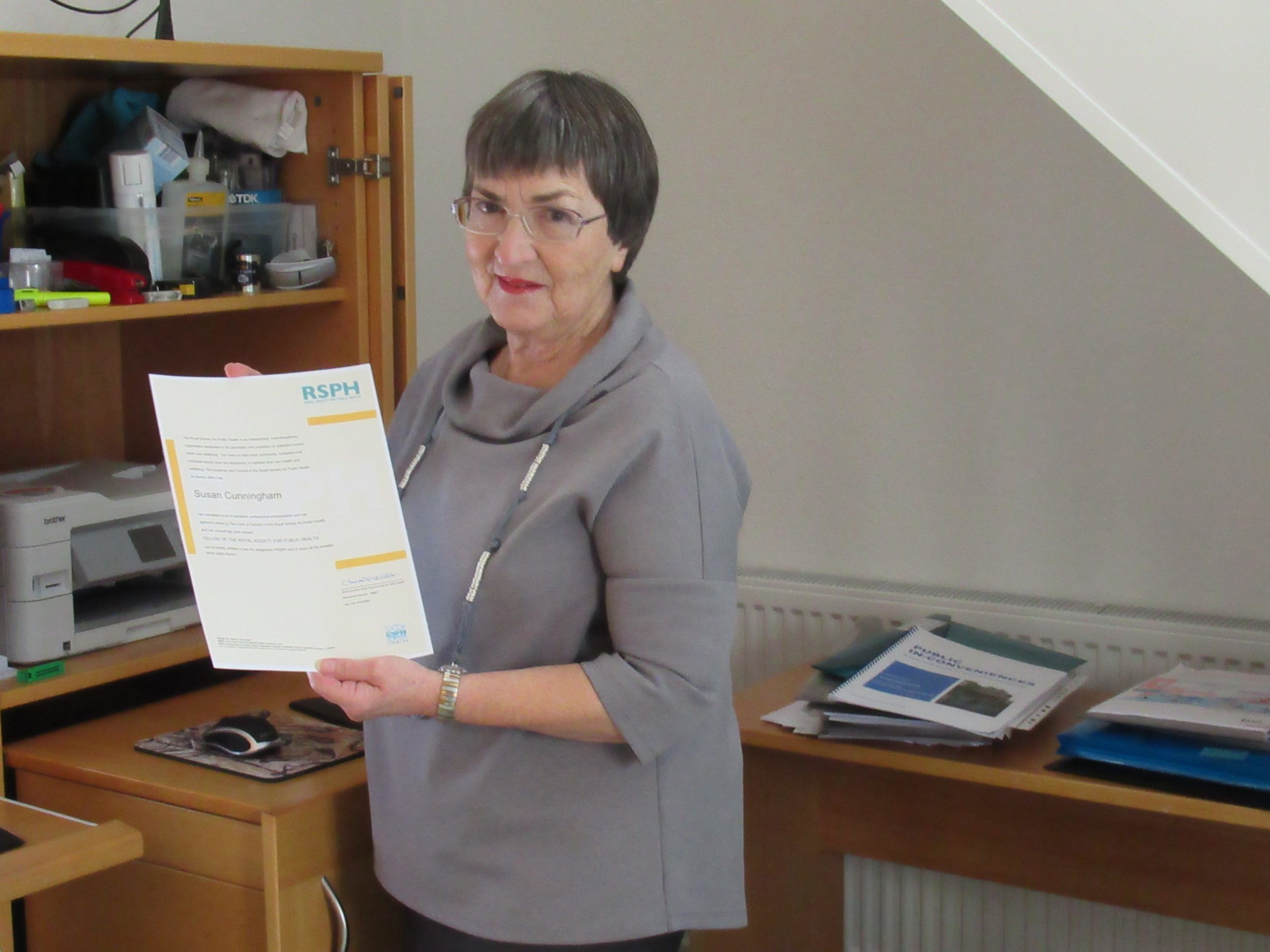
Personally, along with my colleagues in the BTA we pay tribute to one of this organisations founding members; as we congratulate Sue Cunningham on becoming a Fellow of the RSPH this year. Sue has been an ardent campaigner for woman’s rights and decent public provision for over 20 years and this fellowship must reflect and recognise her continuous fight for the maintaining of exemplorary stanards
“In May 2019, the Royal Society for Public Health published a comprehensive report revealing the dire state of our publicly available conveniences and the consequent impact on community health.
I have always admired the work carried out by the RSPH, and their dedication to the promotion and protection of collective human health and wellbeing.
As an Honorary Member of the BTA, I am delighted to have been elected Fellow of the Royal Society for Public Health, which entitles me to benefit from all the sources of information which they make available to their members. I feel sure this will enable me, with renewed vigour, to continue campaigning for improvements in the provision of well-designed, well-maintained, and hygienic public toilets”
Susan Cunningham FRSPH 18th December 2020
Hon Member of the BTA
The winners have been announced for the very first Technology & Marketing Awards, specifically for the cleaning, hygiene and facilities management sectors.
Organised by LaCerta, the awards were free to enter and were a chance for marketing & PR professionals, leaders, CEO’s or anyone working on exciting campaigns to showcase and share their success. A long line-up of high-profile judges from top companies, including Universal Pictures, Samsung, England Rugby and Nespresso helped select the winners after considering factors like overall strategy, communication and creativity
Influencer / Impact Award – Susan Cunningham – for her Public In-Conveniences guide and her exceptional contribution to improving toilet provision in the UK
***DOUBLE CONGRATULATIONS !***
LEGIONAIRES DISEASE
Managing legionella in hot and cold water systems
The official APPROVED CODE of PRACTICE from the HSE is ACOP L8 and can be found at:
https://www.hse.gov.uk/pubns/books/l8.htm
What is legionella?
Legionella bacteria is commonly found in water. The bacteria multiply where temperatures are between 20-45°C and nutrients are available. The bacteria are dormant below 20°C and do not survive above 60°C.
Legionnaires’ disease is a potentially fatal type of pneumonia, contracted by inhaling airborne water droplets containing viable Legionella bacteria. Such droplets can be created, for example, by: hot and cold water outlets; atomisers; wet air conditioning plant; and whirlpool or hydrotherapy baths.
Anyone can develop Legionnaires’ disease, but the elderly, smokers, alcoholics and those with cancer, diabetes or chronic respiratory or kidney disease are at more risk.
HSE’s Legionnaires’ disease page provides information on managing the risks
What you need to do
Health and social care providers should carry out a full risk assessment of their hot and cold water systems and ensure adequate measures are in place to control the risks.
Using temperature control
The primary method used to control the risk from Legionella is water temperature control.
Water services should be operated at temperatures that prevent Legionella growth:
- Hot water storage cylinders (calorifiers) should store water at 60°C or higher
- Hot water should be distributed at 50°C or higher (thermostatic mixer valves need to be fitted as close as possible to outlets, where a scald risk is identified).
- Cold water should be stored and distributed below 20°C.
A competent person should routinely check, inspect and clean the system, in accordance with the risk assessment.
You must identify ‘sentinel’ outlets (furthest and closest to each tank or cylinder) for monthly checking of the distribution temperatures. You should also check the hot water storage cylinder temperatures every month and cold water tank temperatures at least every six months.
Stagnant water favours Legionella growth. To reduce the risk you should remove dead legs/dead ends in pipe-work, flush out infrequently used outlets (including showerheads and taps) at least weekly and clean and de-scale shower heads and hoses at least quarterly. Cold-water storage tanks should be cleaned periodically and water should be drained from hot water cylinders to check for debris or signs of corrosion.
Design systems to minimise Legionella growth, by:
- keeping pipe work as short and direct as possible;
- adequately insulating pipes and tanks;
- using materials that do not encourage the growth of Legionella;
- preventing contamination, eg by fitting tanks with lids and insect screens.
Additional controls
Water samples should be analysed for Legionella periodically to demonstrate that bacteria counts are acceptable. The frequency should be determined by level of risk, in accordance with the risk assessment.
Other control methods
Other methods to control Legionella include copper and silver ionisation and biocide treatments (eg chlorine dioxide). To ensure that they remain effective their application will need suitable assessment as part of the overall water treatment programme including proper installation, maintenance and monitoring.
Further information
- Hot and cold water systems.
- HSE Website – Legionnaires’ disease – provides guidance on managing the risks.
- Legionnaires’ disease. The control of Legionella bacteria in water systems (L8) – sets out both established standards for managing the risks from Legionella and provides guidance on how to comply with the law.
- Health and safety in care homes (HSG220) – provides guidance on how to manage the risks at care homes.
- HPA Website – Legionnaires’ disease – provides information on Legionnaires’ disease and the requirement to report cases in England and Wales to the HPA.
T I N K L E

The TOILET INNOVATION and NEW KNOWLEDGE EXCHANGE has just been launched today and over the coming days and months we will see the opportunities for individuals and groups to gain comprehensive knowledge of the changes affecting our industry. Changes that effect our everyday lives when we need to find a bathroom quickly and how the suppliers and providers are coping with the long term effects of CoronaVirus (Covid-19) when it comes to keeping our bathrooms and washrooms safe and hygienic.
COMING SOON
There are three elements to the Toilets Innovation and New Knowledge Exchange:
RESOURCES
Helping you to find existing knowledge through our filtered resource bank of guidance, standards, regulation, toolkits, websites and research from UK organisations and beyond.
NETWORK
For visitors who seek expert or peer-to-peer advice, here you can find a range of experts across many aspects of toilets who are available to contact.

FORUM
The forum is open to all, to ask and answer questions, seek solutions, debate ideas, share new resources, support campaigns and enable research. Join in!
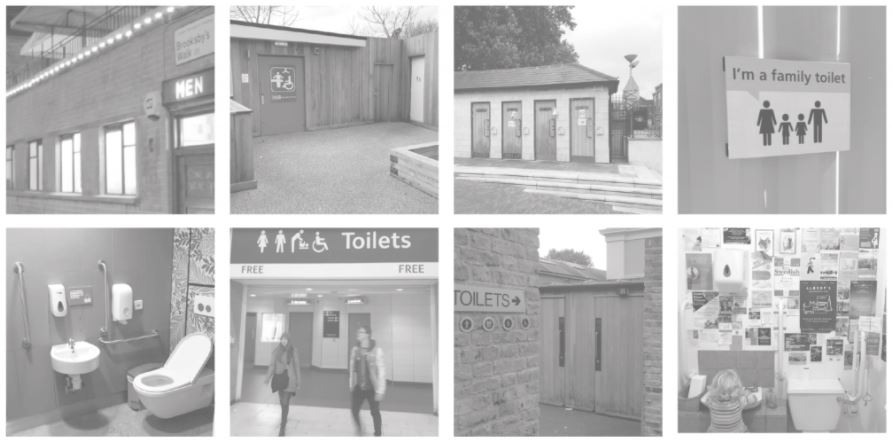
TINKLE is managed by the Public Toilets Research Unit (PTRU) at the Royal College of Art, in partnership with the Toilet Consortium and the British Toilet Association
The PTRU is part of The Helen Hamlyn Centre for Design. The PTRU undertakes inclusive and people-centred design research to improve toilet provision for all.
World Toilet Day 19th November 2022

WORLD TOILET DAY 2022: SUSTAINABLE SANITATION AND CLIMATE CHANGE
Climate change is getting worse.
Flood, drought and rising sea levels are threatening sanitation systems – from toilets to septic tanks to treatment plants.
Everyone must have sustainable sanitation that can withstand climate change and keep communities healthy and functioning.
Sustainable sanitation systems also reuse waste to safely boost agriculture and reduce and capture emissions for greener energy.
World Toilet Day is a United Nations Observance that celebrates toilets and raises awareness of the 4.2 billion people living without access to safely managed sanitation. It is about taking action to tackle the global sanitation crisis and achieve Sustainable Development Goal 6: water and sanitation for all by 2030.
“The BTA fully supports the work of the World Toilet Orhanisation and its partners. It is our goal to fight for our Human Rights in all aspects of toilet provision and strive to raise the stanards of hygien and cleanliness in all “away from home” facilities throughout the United Kingdom and across the world”
Raymond Martin
Managing Director for and on behalf of the British Toilet Association Ltd
Response from Minister Luke Hall
The BTA sent a number of letters to Government and individual ministers in the past several weeks/months offering advice, guidance and our full support for the fight against this CoronaVirus pandemic.
Below is the response from the MHCLG
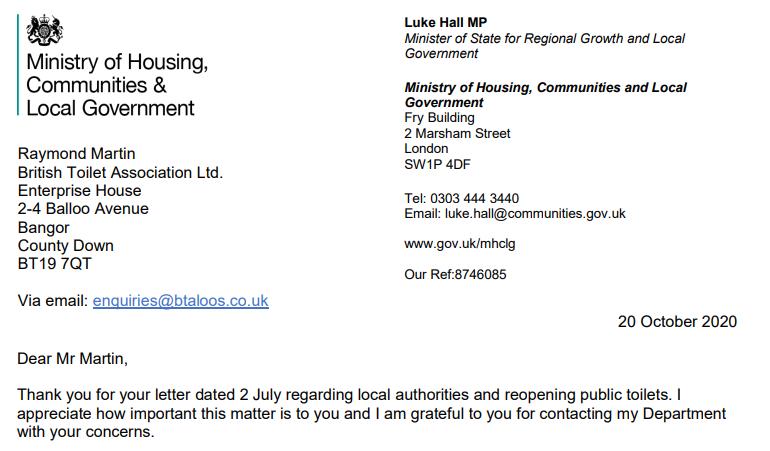
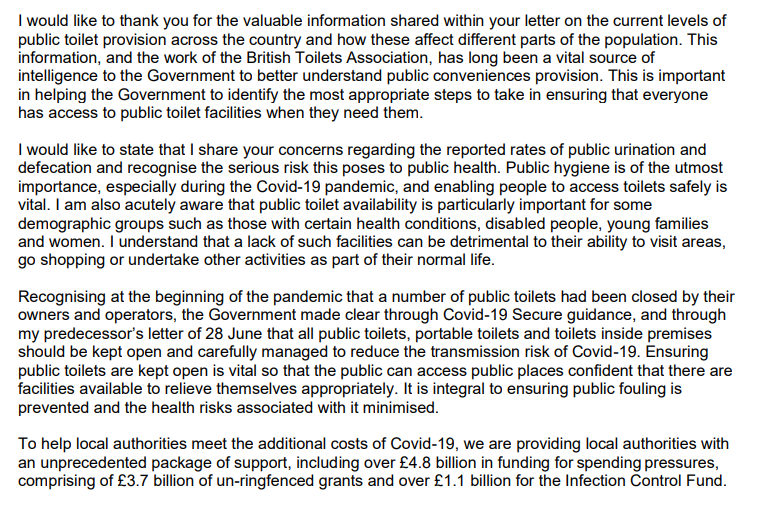
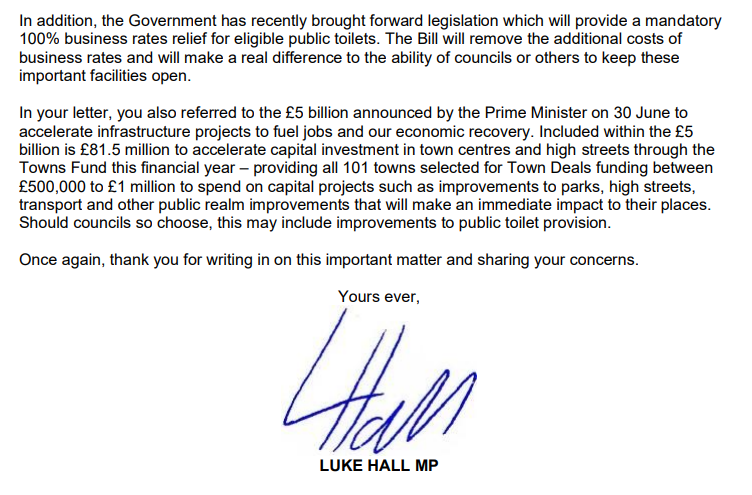
The BTA will contiue to work with all parties and government departments to encourage some form of direct action by this and future administartions to find a lasting solution to the ever increasing rationalisation of Publicly Accessible Toilets across the UK and Ireland.
With this NEW threat comes new opportunities for manufacturers and suppliers to develop goods and services to take our hygiene levels to a new level.
Human beings – of every age and ability – need to constantly use the toilet, sometimes several times a day, and we need the certainty that when we move from place to place that we can find a clean, hygienic well provisioned publicly accessible toilet within easy reach.
The Manchester Cleaning Show 2020
As a board member of the British Cleaning Council the BTA is delighted to support the Manchester Cleaning Show event and has provided you with a LINK to the show webpages. Hope this is helpful !
Manchester Cleaning Show is going virtual
from 14-15 October 2020
We don’t want to wait until September 2021 to see you all again. Our exhibitors have products that can help the UK get back to business now; and so many individuals need the support and the contacts that this event brings. The UK cleaning industry has demonstrated resilience, adaptability, and innovation throughout this pandemic, and there is a wealth of recent experience to share. So we are staging a virtual version of the Manchester Cleaning Show from 14-15 October 2020.
The opportunities that this virtual event presents are exciting and we have a really innovative platform to show you. There are no apps to download and you can view everything on a device of your choice.
So register to join us for free today.
And we look forward to seeing you online in October.
Michelle Andrews
Sales Manager